Take a look at US Pres Barrack Obama's new top economic adviser. The Chair of the Council of Economic Advisers is "funniest celebrity" and "stand-up economist" Austan Goolsbee of the University of Chicago.
This weekend, he did an interview with the ABC's Christiane Amanpour which you can watch here.
And here he is on Jon Stewart's Daily Show explaining the theory behind Obama's policies.
He performed reasonably well, even better than most in the Colbert Report.
Now here he is courtesy of Politico.com doing his stand-up routine awhile back. With poverty in America set to hit 15% (the same as in the 1960s when LBJ launched the "War on Poverty" or the "Fair Deal" and with unemployment still above 9% and with appetite for new stimulus gone sour in the US Congress, perhaps injecting some humour and laughter into the debate would be the best medicine for policymakers and the public at large.
Monday, September 13, 2010

Wednesday, September 8, 2010
The Price of Happiness
- The Wealth Report says that $75,000 is the minimum income threshold that produces happiness in the US based on a study principally led by Daniel Kahneman, a Nobel winning behavioural economist.
- Real Time Economics goes further by translating this figure on a city-by-city basis.
- While we are on the subject, this article from Time tells us why drinkers live longer.
- Finally, this post from Slate shows how inequality has grown in the US over the past 30 years.
Monday, August 30, 2010
Could Austerity Be the Key to Growth?
David Brooks takes his cue from developments in Germany and Great Britain to highlight the merits of austerity which in his terms is the "adult" way of managing the economy. He draws most of his insights from a blog called e21 which posted this editorial on the German economic recovery. Some analysts warn that the below-trend growth that is expected from the US in the coming years is an even worse outcome than a double dip recession that lasts for a few quarters followed by a return to normal growth immediately after. The reason for such stagnancy is the expectation of firms and households that government indebtedness will affect the hip pocket in the coming years. Although the US in all likelihood will avoid a double dip because of its stimulus, is now the time to be thinking about austerity given the seeming ineffectual nature of fiscal spending?
Friday, August 27, 2010
Overconfidence Explains Failure Rates
Thanks to the Nudge blog, I found two interesting reads. They both deal with overconfidence. Overconfidence in our ability to learn as consumers for instance leads us to buy stuff thinking we can easily pick things up, like playing a new sport or a do-it-yourself project. This also explains the high drop out or non-completion rates observed in technical training. Overconfidence also leads entrepreneurs to start new ventures that have a low probability of success.
How would better policies inform the decisions of such actors to produce better outcomes, I wonder.
How would better policies inform the decisions of such actors to produce better outcomes, I wonder.
Tuesday, August 17, 2010
Not Monty Python
First Obama, then Cameron found a way of absorbing the new theory of Nudge into its agenda. When will libertarian paternalism make its way to Australia?
Thursday, July 29, 2010
Why Good Kindies Matter
It was good enough for Greg Mankiw to mention in his blog. This new study out that counters the "fade out" effect that kindergarten had on long-term learning outcomes. The previous method of measuring success used test results. This study uses pay. Although it is yet to be peer reviewed, the findings are potentially explosive.
Saturday, July 24, 2010
PM's Clothes Signal Her Intentions
Based on a study from Plymouth University, personal hygiene and cleanliness dispose individuals to deal better with morally questionable situations (if you want to read more on this, go here). Think of Lady Macbeth as she sought to cleanse her hands of invisible bloodstains having convinced her husband to commit regicide against his kinsman in Shakespeare's tragic tale. Think of those characters in CSI dressed in their white lab coats clinically inspecting the compromised bodies of their "vics".
This knowledge made me sensitive to the way PM Julia Gillard has suddenly taken to donning pristine white outfits like the one she wore here after presiding over the political demise of her former "boss", Kevin Rudd. I wonder if there is a wardrobe consultant advising her or if this is a subconscious play on her part as she appeases voters wary of how Mr Rudd's sacking was handled by the Labor party.
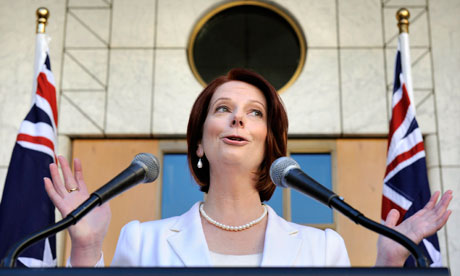
As she announced her intentions on climate change (a highly contentious set of policies characterised as being more brown than green), she was again wearing the same suit. It could perhaps be symbolic of her willingness to compromise on what was the "greatest moral challenge of our generation" for the sake of some voters in marginal seats. At any rate, the latest polls showing an expanded lead for Labor over the Coalition on a two party preferred basis and her better ratings as preferred prime minister would show that her clinical approach to the campaign is paying off.
Thursday, July 22, 2010
Too much nudging, not enough shoving
The case against behavioural economics being used in public policy ironically has been made by two prominent figures from within the field. I am referring to George Lowenstein and Peter Ubel who have argued in the New York Times against the tendency of taking the politically convenient route of applying nudges which are based on informational cues to improve decision-making to problems which are best solved by traditional tools from traditional microeconomics which use price signals such as taxes and subsidies.
Within the context of the debate over climate change in Australia, the two leading parties, Labor and the Liberals, have opted for "direct action" and balked at imposing a price on carbon immediately contrary to both their platforms in 2007. This is a prime example for how one set of policy tools have been substituted for another due to the inherent unpopularity of the latter with voters. One of the main discoveries made by behavioural economics is that in making lifelong decisions such as whether to make tiny sacrifices today in exchange for a large payout tomorrow, people tend to put a greater weight on the short-term pain.
If left to their own devices, people tend to procrastinate up until the last minute to deal with such questions. That is why savings has been less than adequate from a social standpoint in most advanced economies and why action on climate change has not been forthcoming from governments who are expected to heed the will of the people (who are fickle and irrational according to the theory). Nudge theory is conceived of as being paternalistic libertarian in the sense that it tries to account for human frailties in designing policy interventions without restricting individual choice or socialising the cost of such interventions. The question is whether or not nudging people is adequate in response to existential threats such as climate change or whether a shove is better at least initially to affect the calculations made by individuals over decisions that have long-term consequences.
Subscribe to:
Posts (Atom)